

?unique=e0640c8)
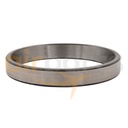

13889 – Tapered Roller Bearing (Cup & Cone Assembly)
Now Superseded by Part Number: 13889-20629
Available now on the Airparts.aero Marketplace.
The 13889 is a high-load, precision-engineered tapered roller bearing assembly designed for heavy-duty rotation in aircraft landing gear wheels, auxiliary gearboxes, and flight control actuators. As a tapered bearing, it is uniquely designed to handle simultaneous Radial Loads (perpendicular to the shaft) and Thrust Loads (parallel to the shaft), making it a critical component for aircraft wheel hubs that must endure extreme side-loading during crosswind landings and taxiing maneuvers.
The part has been superseded by 13889-20629, which represents a modernized manufacturing standard. The newer dash-number (-20629) typically denotes an improvement in material purity, specialized heat-treatment of the raceways, or a higher-precision surface finish (Super-finish) to reduce rolling resistance and extend Service Life Limits (SLL).
Key Features
Tapered Geometry: Allows for the efficient transfer of combined loads, providing superior stability compared to standard ball bearings in high-impact environments.
Case-Hardened Steel: Manufactured from high-vacuum degassed steel that has been case-carburized to provide a hard, wear-resistant outer shell and a tough, shock-absorbent core.
Interchangeability: The "13889" designation refers to the industry-standard dimensions for the cone (inner ring) and rollers, ensuring compatibility with standard 13830 or 13836 series cups.
Reduced Friction Profile: The superseded 13889-20629 features optimized roller-to-rib contact geometry to minimize "skidding" and heat generation during high-speed takeoffs.
Precision Cage Design: Utilizes a stamped steel or high-strength polymer cage to maintain exact roller spacing, preventing "bunching" and ensuring uniform load distribution.
Technical Specifications
Original Part Number: 13889
New Part Number: 13889-20629
Manufacturer: Typically Timken, SKF, or Koyo (Aerospace Division)
Component Type: Tapered Roller Bearing (Cone)
Bore Diameter (d): 1.5000 in (38.100 mm)
Width (B): 0.6500 in (16.510 mm)
Static Load Rating (C_0): High-capacity (Refer to OEM Load Tables)
Dynamic Load Rating (C_1): Optimized for high-frequency cyclic loading
Certification: FAA-PMA / OEM Original Equipment
Aircraft Compatibility
General Aviation: Widely used in main and nose wheel assemblies for Cessna (210, 310, 400 series), Piper (Navajo, Cheyenne), and Beechcraft (Baron, Bonanza).
Light Turboprops: Found in various landing gear architectures for King Air and Pilatus platforms.
Vintage/Classic Aircraft: A standard dimension bearing for many legacy landing gear systems.
Note: Always verify the specific cup/cone combination in your aircraft's Illustrated Parts Catalog (IPC) to ensure the correct "set" is installed.
Applications
Wheel Hub Assemblies: Supporting the aircraft's weight and absorbing lateral forces during ground maneuvers.
Accessory Gearboxes: Providing low-friction support for high-speed internal shafts.
Hydraulic Actuators: Supporting the pivot points of landing gear retraction mechanisms.
Why Upgrade to 13889-20629?
In the landing gear environment, bearing fatigue is the leading cause of wheel hub failure. The 13889-20629 is engineered to address the "spalling" issues often seen in older 13889 units. The superseded version utilizes controlled-contour rollers, which slightly taper the ends of each roller to prevent "edge loading"—a condition where the pressure at the edge of the roller exceeds the material's yield strength. By upgrading to the -20629, operators benefit from a more even stress distribution across the raceway, leading to fewer "noisy" bearings and extended intervals between wheel overhauls.
Note: Bearings are precision instruments. They must be handled with lint-free gloves and packed with the correct MIL-SPEC grease (e.g., AeroShell 22 or Mobilgrease 28) as specified by the wheel manufacturer. Never spin a dry bearing with compressed air, as this can cause catastrophic surface damage (galling).7 Installation and "end-play" adjustment must be performed by a certified A&P mechanic.
